


News
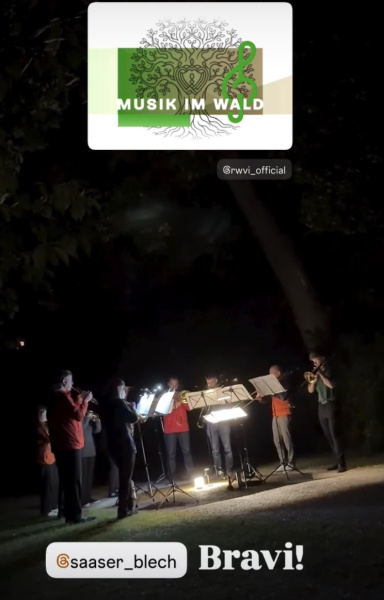
On 21 August 2026, at half past nine in the evening, guests entered the grounds of Schloss Fantaisie. The sound of brass echoed through the trees: the young ensemble Saaser Blech launched a surprise concert that briefly transformed the surroundings into a concert hall. It was one of the special moments of an evening in which music, history, nature and international encounters came together.
With Musik im Wald, the Richard-Wagner-Verband International marked the 150th anniversary of the Bayreuth Festival. The programme brought together Wagner’s history surrounding Fantaisie with music and the unique setting of the castle grounds.
The Evening at a Glance
The weather gods, however, weren't entirely cooperative that evening: it rained almost continuously, so the aperitif, dinner and reading were promptly moved indoors to the Café Schloss Fantaisie. Only one part of the programme refused to be deterred – and became all the more magical for it.
Early arrivals were rewarded: from 5 p.m., the legendary Wagner Room, just a few steps from the Café Schloss Fantaisie, opened for an exclusive guided tour. This is where Richard Wagner lodged for five months in April 1872, before the Festspielhaus even existed – a place where history still feels tangible, with original furniture and an atmosphere still used today for private concerts and readings.
At 6:30 p.m., the Café Schloss Fantaisie opened its doors, before the evening proper began at 7 p.m.: aperitif and starter, accompanied by music and history – held cosily inside the café rather than on the terrace due to the rain. The second course followed at 8:15 p.m., also indoors, before a literary journey through time began at 9 p.m. The highlight and big surprise of the evening was the concert in the forest at 9:30 p.m. – held outdoors, rain or not. The evening drew to a close at 10 p.m. with dessert in the café.
The Contributions and Contributors
The evening was carried by voices that brought both history and music to life in equal measure.
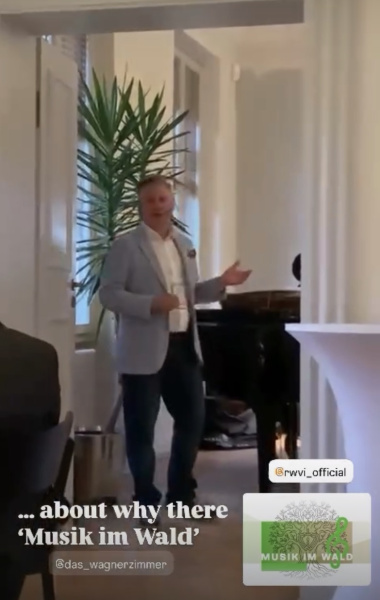
Dr Frank Piontek, a Bayreuth Wagner expert with numerous books and essays to his name (including Genius loci. 150 Jahre Richard Wagner in Fantaisie), took guests back to the year 1872 during the aperitif in the café: he spoke about the laying of the foundation stone of the Festspielhaus on 22 May of that year – the very occasion the anniversary evening was marking.
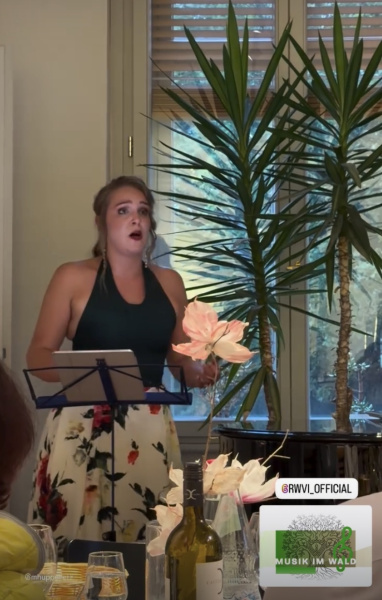
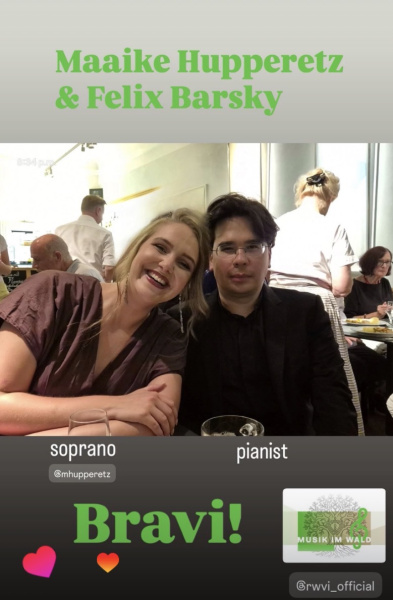
This moment was accompanied musically by Maaike Hupperetz, a Dutch soprano and member of the Festival Chorus, who sang several Wesendonck Lieder. The young singer, a recipient of the Wagner Scholarship with concert experience ranging from Crete to the Vatican, brought a touch of grand stage experience into the intimate, rain-proof setting of the café.
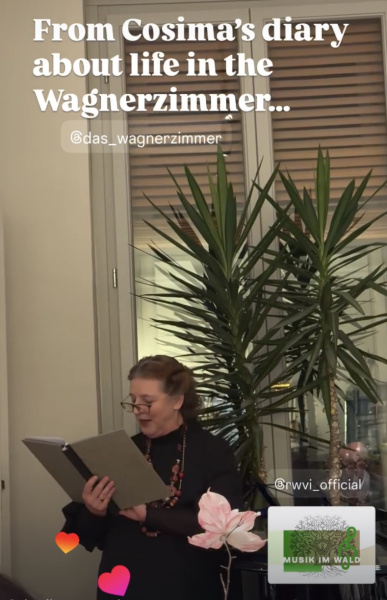
After the second course, Birgit Franz took the floor: the actress from Studiobühne Bayreuth read from Cosima Wagner's diary in the café, recounting the Wagner family's stay in the Wagner Room – and how the park itself inspired the Master. A reading that once again wove together the evening's locations – the Wagner Room, the café, the park – in literary form, even if the view through the window was grey on grey this time.
The Surprise Concert in the Forest
The real highlight of the evening, however, was acoustic – and it emerged from the darkness of the trees despite the rain. At 9:30 p.m., conversation in the café fell silent as guests ventured out into the dripping-wet park, and music rang out from the forest: a moment deliberately designed to evoke the intimate musical evenings Wagner himself held so dear – one that took on an almost mysterious quality of its own as rain pattered on leaves and brass alike.
The surprise was provided by Saaser Blech, the youngest brass ensemble in the region – young in two respects: founded only in the summer of 2022 out of a spontaneous idea shared by three friends who, after ageing out of the Bavarian Youth Trombone Choir, wanted to keep making music together in Bayreuth, the now roughly 14-strong ensemble has an average age under 30. High-school graduates, university students and working parents are united above all by their passion for music and a close-knit friendship.
The programme in the forest spanned a wide arc – from Anton Bruckner's Locus iste to Wagner's prelude to Die Meistersinger and the Pilgrims' Chorus from Tannhäuser, through to Mendelssohn's Elijah and contemporary works such as Jacob de Haan's Yellow Mountains or Dieter Wendel's peace prayer Dona nobis pacem. Anyone curious how Bach and film music could meet within a single ensemble found the answer right here – in the middle of a rain-soaked forest, beneath dripping trees, with the sound of brass echoing between the trunks.
"Musik im Wald" was more than a concert evening – it was an invitation to experience Bayreuth's Wagner history in a new, youthful way: with good food, literary journeys through time, and a surprise moment that defied even the rain, proving that classical music sounds loveliest exactly where you least expect it.